
February 24, 2026
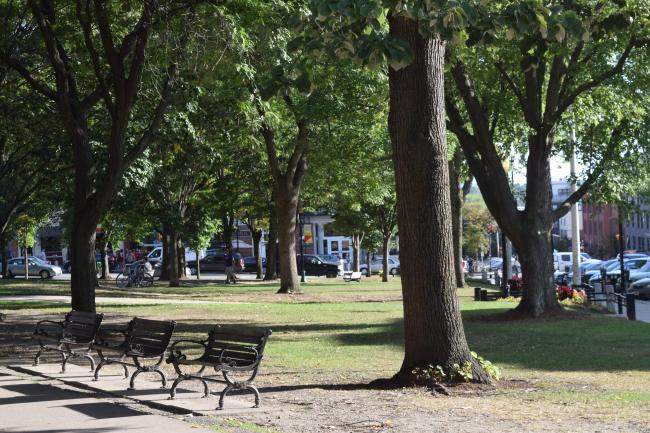
Main Point: Mulch is the best first step to protect trees in lawns.
We love our trees on town greens and playgrounds, but all too often, we love them to death.
The area close to the tree’s trunk draws frequent use because people love to sit there or just leave a backpack in the shade to go run in the grass. Unfortunately, the very enjoyment of these lawn trees is an added stress that can often lead to root rot and decline.
The two main ways we love our trees to death are with lawn mowers and with foot traffic – two sources of mechanical injury and soil compaction.
Mower Blight:
In the course of maintaining the lawn, mowers and string trimmers often damage the tree roots and trunk flare, repeatedly leaving open wounds that allow fungal and bacterial infections to enter the tree. We see this so often that it has a name: Mower Blight. These infections can enter the roots or trunk flare and then travel up and down the tree’s vascular tissue. Imagine the drinking water pipe entering your house has a leak in it with dirt coming in. The normal usage of your water will create a current that draws contaminants throughout all your pipes. Trees move water in a similar way. In this example, the peeled bark (pictured below) resulting from lawn mowing is the leak in the pipe.
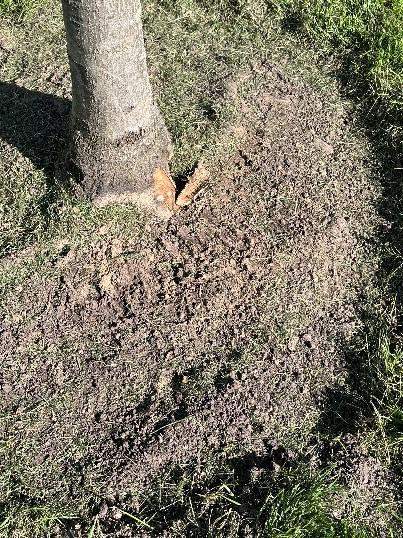
The picture to the left shows a tree with lawnmower tracks (soil compaction) and mower blight damage on its trunk flare. A very common sight.
Soil Compaction:
Heavy foot traffic impacts soil structure. Healthy soil should be spongy, filled with tiny pockets of air and water that allow the tree roots to drink and respirate. Downward pressure that crushes these pockets is called soil compaction and it deprives the tree of water and air. Imagine stepping on a sponge and watching the water pour out as bubbles of air escape at the same time. The pressure of your foot, has crushed the open spaces in the sponge that would have held water and air.
What can you do?
The solution is simple. Protect the root zone with mulch. Mulch is very beneficial to trees and it is reminiscent of the annual addition of leaf litter all over the forest floor, protecting the soil and the roots like a blanket, and feeding the macro and microorganisms that are essential to forest and tree health.
Mulch provides physical padding to the roots and soil protecting them from mechanical damage. So, the next time someone needs a reading spot, the tree will be safe.
The photo at right, courtesy of University of Vermont Lecturer Luben Dimov, shows students applying proper mulch coverage for a newly planted red oak. The root flare is visible, there is a round berm of mulch around the tree, and the mulch is not touching the trunk itself.
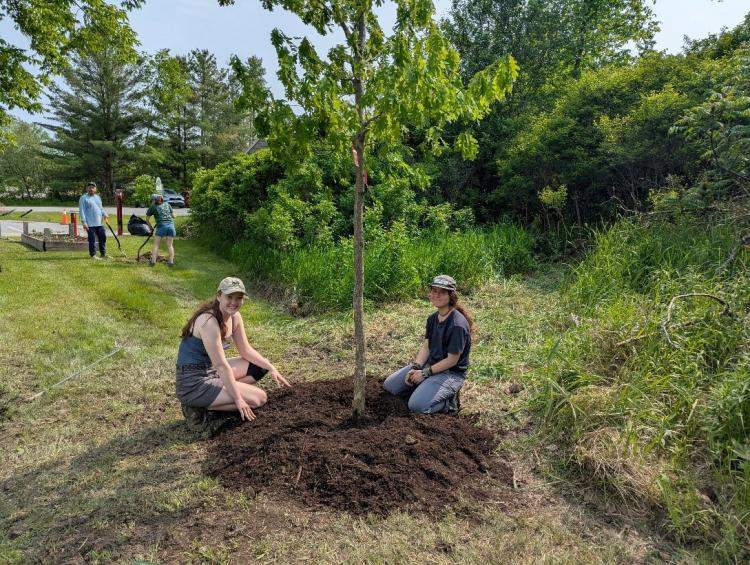
The tree and the landscaper alike benefit from a wide mulch bed that suppresses grass and weeds next to the tree trunk. This allows the lawnmower more of a buffer to prevent contacting the sensitive wood. This will prevent repeated nicks and cuts on the surface roots, so new wood can grow over old wounds.
Mulch helps maintain soil moisture that the tree needs, allowing it to infiltrate toward the root zone, and slowing evaporation that dries out soil between rain events. Yet over time, more benefits will accrue. The mulch will break down into nutrients for the tree as well as help the soil regain both its microbiota and its porosity that the tree needs to be healthy.
How to Mulch:
When mulching a tree it’s essential to keep the mulch about an inch away from the trunk. Mulch shouldn’t be more than 3 to 4 inches thick, but it can be spread out as far from the tree as you can tolerate aesthetically. Larger trees appreciate wider (but not deeper) areas of mulch around them.
How Not to Mulch:
Of course, there can be too much of a good thing. Never pile up mulch against the trunk of the tree (volcano mulching). Too much mulch will strangle the tree by causing girdling roots, or by being so thick that it repels water and limits oxygen, disadvantaging the tree in similar ways to soil compaction. To make matters worse, mulch can trap moisture around the trunk and make it prone to rot.
Next time you’re wondering if a tree needs some help, don’t look up, look down. Using proper mulch to address the impacts of mower blight and soil compaction will always be a good place to start.
Adam McCullough, VT UCF Urban Forester