
December 18, 2025
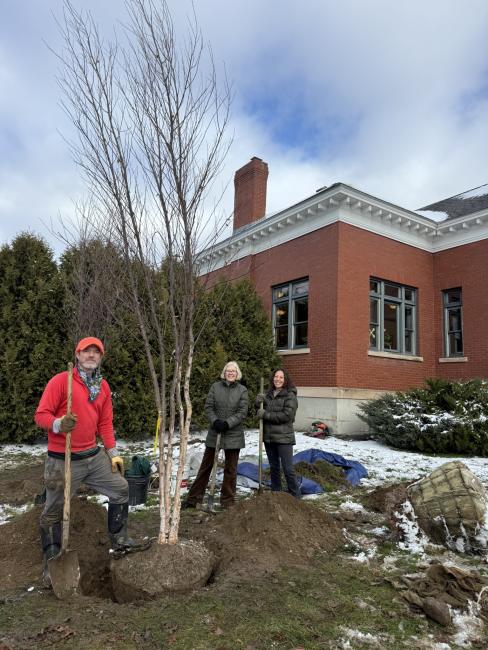
This fall Morristown Centennial Library and Northfield Elementary School partnered with VT UCF to complete urban forestry improvements. Tree species were placed intentionally to deliver targeted benefits on their grounds, so they can offer more shade, year round enjoyment, and ecological services to their patrons
Morristown Centennial Library was one of three libraries selected as partners for the pilot year of our Check Out Forestry initiative. Striving for year-round function and beauty, a northern red oak was planted at the back corner of the property, to gain a large patch of dense shade over their most highly used outdoor summer space. Their new mini apple orchard surrounded by a protective seat/wall for children’s storytime gives visitors a new reason to use an otherwise underutilized lawn. The orchard will flower in early spring, give shade in the summer, and then the apples will be ready to pick in the fall. In the front, four clumps of river birch, planted close together, will form an enclosed reading room, with vibrant bark for winter interest, cooling shade to allow readers to tolerate hot summer days, and golden fall foliage. The front lawn is now framed by two S-shaped edible hedgerows, drawing the eye to the formal columns of the library entryway. The blueberry and chokeberry plants of the hedgerow will give a sense of containment and enclosure to the library’s front lawn, making visitors more comfortable by dividing them from the nearby road. Brilliant reds can be expected every year from both shrubs after the berry harvest has been enjoyed and gone by.
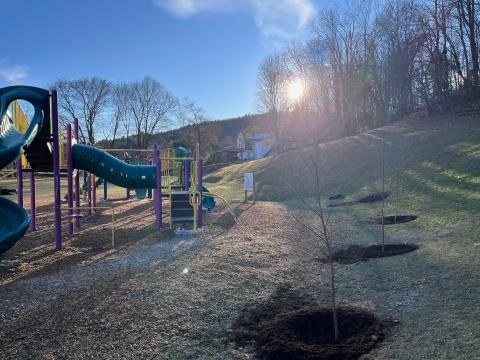
Northfield Elementary School was the selected partner for our Climate Smart Schoolyards project. The school hosts kids all year round with summer camps bridging the gap between school years. The playground, track, ballfields, and basketball court are community resources providing healthy outdoor recreation opportunities that are free to the public. But these amenities had full exposure to southern skies, heating the play surfaces, and leaving very little cover for guardians that supervise the space. The school added two northern red oaks for significant addition of shade in both the dismissal area out front and the playground in the back. The stately playground oak is protected by a chic triangular planting box, so young feet and curious climbers don’t damage the critical root zone and stunt its health. The planting box is positioned in the center of a triangular climbing element for the kids, so in time it will give the impression of a tree house. The tree could grow large enough to provide a very large shadow into the nearby picnic table area. On the other side of the play structure, a curved row of single stem gray birches will stand tall to highlight the dramatic height of the slope behind the play structure and to provide shady respite for children and their guardians alike. The gray birch is a hardy, and seldom planted species that has the beauty of the paper birch, but with more firmly secured bark, less vulnerable to the irresistible temptation of peeling by young hands. Along the south face of the school building, four apple trees will give cover to classroom windows, reducing the interior temperatures, and creating a sheltered area for quieter play, while providing delicious fruit that will help the students fall in love with trees. The oak tree in the front will make a statement while shading the paved entryway of the school where they stand to await pickup at day’s end.
Physical benefits aside, these plantings were engines of urban forestry education that involved multiple partners and volunteers who learned to plant the right trees, in the right place, and in the right way. The truth is these projects were simple, successful, and inexpensive. Neither one cost more than $2,700 and they were fully funded by VT UCF at no cost to the recipients. Even without this financial support, well planned tree plantings pay for themselves quickly through the many benefits trees provide and when trees reach maturity, the return on investment becomes substantial. Most importantly, these two small demonstrations speak for themselves. Hopefully someone will come along and ask, why doesn’t my school have trees like this?